It's a holiday weekend! How about something a little special for breakfast on Monday...?
One of our favorite lazy-morning recipes is crepes. When we first went gluten-free, crepes was one of the first recipes I tried to re-create for our wistful eaters. (Wistful because they were mourning the wheat that had made up such a major part of our diet up to that point...)
It took some tweaking. As it turned out, the key to tasty crepes was in the GF flour mix. Anything with bean flour was unacceptable. (Bean flour adds protein and fiber, but also a distinctive taste that my family won't touch with the proverbial ten-foot pole.) However, our go-to flour mix is perfect for crepes and pancakes.
Crepes are not as hard as they sound!
Here's all you do:
Beat four eggs with 1 to 1-1/4 cups of milk. Add a cup of flour and a pinch of salt and beat until smooth. Unlike pancakes, you don't want lumps. Let mixture sit and thicken while you heat your pan.
Now for crepes, I'll use either a curved-sided stainless steel frying pan with a fair amount of melted coconut oil, or my trusty cast-iron skillet, which requires a lot of oil for the first crepe or two and then develops wondrous non-stick capabilities. We do not use "non-stick" pans per se. Not only do they give off toxic fumes when heated at too high a temperature, but they can shed little particles of chemical non-stick substance into your food. Even if they're new and non-shedding, somehow I just don't trust them. Give me the cast iron skillet instead -- I'll give the high calorie first crepe or two to the people in our household how need the extra calories, and I'll eat the later crepes that require little or no addition of oil. But I digress...
Add grease to your pan (before we cut out dairy as well as gluten, I loved to use butter for this) and swirl the pan to spread the fat. Ladle enough batter into the pan to make a good sized crepe. Now wait. If you try to turn the crepe before it's set, you'll have a mess. You'll know it's set when it starts looking dry instead of wet on top.
Some people pride themselves on pale crepes with minimal browning. We're rather hit-or-miss. As long as they're completely cooked in the middle, and not burned on the outside, they'll disappear at our house.
Usually the first crepe or two are hard to flip, for some reason, maybe it just takes a little practice to warm up. Ease your spatula (the pancake turner kind) all around the crepe, under the edges, until it's loosened from the pan. Then push the spatula deep under the crepe, lift it up, and with a flip of the wrist, turn it over. It only takes a minute or two more to cook the other side, and then you can lift it onto a waiting plate.
I usually try to get a small stack of crepes done (and another cooking) before I let people know they can help themselves. Of course, this wonderful smell fills the air, so they're ready just as soon as I give the good word, standing at my elbow, plates in hand.
Our go-to crepe filling is very simple: just powdered sugar and fresh-squeezed lemon juice. We shake the powdered sugar onto the crepe through a sieve, and follow up with a good squeeze of a lemon wedge. Roll up the crepe and sprinkle some more powdered sugar on top, and voila! Deliciousness! Our girls can eat three or four crepes each, but then they're growing teens. I usually manage one or two.
Recently, our youngest decided to make chocolate filled crepes. She made a simple chocolate ganache (chocolate chips melted with cream), spread it on the crepes, rolled them, sprinkled them with powdered sugar, and drizzled with melted chocolate.
Doesn't that look yummy?
Here's the flour mix I use for just about everything except yeast bread:
2 parts brown rice flour
2 parts white rice flour
1 part tapioca starch
1 part cornstarch
(I used to use potato starch instead of cornstarch, but one of the girls insists it tastes like bean flour to her. Since we don't have problems with corn, it works for us. I guess if we couldn't use corn I'd have to investigate some other option, like millet flour or arrowroot.)
Enjoy!
Friday, May 25, 2012
TOS Crew: Heritage History
Here it is, my final TOS Crew review for the 2011-12 voyage. I've been on the Crew for four cruises now, and it's time to disembark. It has been an amazing experience, and I have to admit I've been dragging my feet, procrastinating fiercely on this review, not wanting it all to be over. But all things must come to an end...
Speaking of which, we're ending with a "goodie" -- especially if you're a bookaholic, as I am. Heritage History provides resources for a living books approach to history. (What is a living book? Here's an explanation I wrote some time ago.)
Members of this year's Crew were given the opportunity to review one from a selection of history curriculum CD libraries, which range from ancient times to the modern era -- pre-1923. As any lover of vintage books and reading probably knows, 1923 is an important year regarding copyright issues. Editions of books published before that time are considered "public domain" which means they are free to copy and distribute without cost. You can find oodles of free e-books on the web, more every year. I remember combing the Project Gutenberg website for old books in our early days of homeschooling, when we were just discovering the delights of reading living books.
It still amazes me that in our early years of homeschooling, when someone would ask our girls to name their favorite subject, the answer would be "history." You see, I detested history in school. I chalk it up to the difference between history textbooks, which suck all the life out of the subject, and living books. When we began our homeschool journey, we started with textbooks because it was all I knew. (We burned out pretty quickly, too.) We tried several approaches before stumbling upon Charlotte Mason's philosophies. Combining her methods with a good booklist, we got the feeling we'd hit the jackpot.
(Actually, sometimes I wondered what we were doing wrong, once we'd settled down to reading aloud together from interesting historical fiction and biographies, and having the girls tell back each story in their own words. It didn't seem like "school." It wasn't! It was learning!)
Heritage History has gathered together a large collection of books written before 1923, on three reading levels: elementary, intermediate, and advanced. The elementary books are not picture books, but most are at a fourth grade reading level or above. Advanced books are suited to high school students, and "intermediate" means just that. With books of all three levels on one Heritage Classical Curriculum CD, you have a virtual library for all ages.
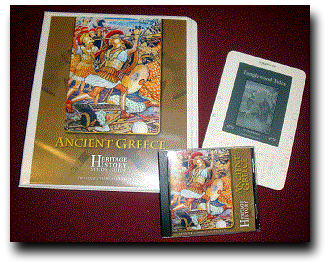
Along with e-books in three formats (view on the computer, read on an e-reader, or print and read), you'll find study helps. Introductory material explains the philosophy behind the collection. A printable Study Guide provides reading suggestions for each reading level, a list of study suggestions arranged chronologically, a map collection (both colorful vintage maps and outline maps suited to student mapwork) to go with the reading, and reproducible forms to keep track of your student's progress. In addition you'll find teaching aids, including suggestions for a course of history study. I printed out the Study Guide and put it in a binder for reference, but you can also read it on your computer.
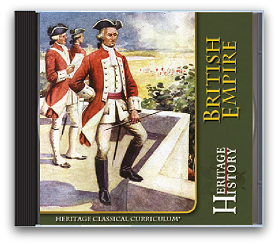
Our family received the British Empire collection, which covers the time period from 1707 to 1922. (Let me tell you right now that it was hard to choose just one CD out of the collection!) Click here for a description of the materials, plus a book list. The CD contains the complete illustrated texts of 57 vintage books plus a collection of over 50 maps, along with all the study materials mentioned above (and more... I didn't even mention the battle dictionaries, geography terms, short biographies, or historical summaries!). British Empire CD is available for $24.99.
If you want to get a flavor for the books, you can read them online at the Heritage History website, along with helpful discussions of how to use living books in your history studies. (I can't tell you how many e-books we've read online over the years, or printed out and put in a binder to read on the couch. One of the things I love about the Heritage History collection is that it pulls together books of a similar theme, time, and civilization and puts them in a format I can download to our e-reader.)
This is history the way we love to study.
Read more TOS Crew reviews of Heritage History materials at this link.
Disclaimer: Our family received a British Empire CD for review purposes. No additional compensation was involved.
Tuesday, May 15, 2012
TOS Crew: Judah Bible Curriculum
This is such a big review, it's hard to know where to start! You see, the Judah Bible Curriculum is a product that you can use year after year, with your whole family, from the early years (kindergarten, perhaps) through grade 12.
This is Bible study according to the Principle Approach (click on the link for more detail). This curriculum is based in the values of the sovereignty of God and the responsibility of the individual (with an emphasis on self-government). This is no surface, shallow, fill-in-the-blank study, nor is it merely reading the Bible together and answering discussion questions. The methodology employed is aimed at getting the students to think about what they've heard or read, to interact with the material, to learn to use study aids and to take Bible learning into themselves, where it becomes such a part of them that they gain a deep understanding of God and His purposes and Providence.
"Building Godly character into your students" is also a stated aim of the curriculum, achieved through study of individuals and events and learning from biblical examples.
This is a teacher-intensive study. Don't expect to be able just to jump in. While there is plenty of helpful material to help the teacher prepare lessons, even examples of the first few lessons. You can get an idea of how a lesson works by viewing a sample. (One of the things I like about the sample is it gives you the opportunity to listen to the first in a set of teacher-training audios that come with the curriculum.)
In the course of study, you go through the Bible in a year, focusing on five themes, the first semester in the Old Testament and the second semester in the New (see this link for more detail). You repeat the themes each year, every year with a slightly different emphasis and more in-depth study. Work for little children is mostly oral, or drawing pictures, while older students learn to organize learning and express their thoughts in writing.
Within each theme there are keys to study: key individuals, key events, key institutions, and key documents (which may not just occur in written form). During your studies, you and your students will create notebooks -- but these are not mere records of study, but valuable tools for future study and teaching. (I found the booklet of sample pages from student notebooks very helpful!)
Together you will read Bible passages, memorize scripture, fill in key worksheets (so much more than mere worksheets), and, perhaps most importantly, begin to apply scripture to your life.
The key worksheets were somewhat familiar to our family, as some of them were similar to Bible and character study we've done in the past. I was impressed by the teacher helps on the website, along with the Judah Bible Curriculum Manual that explains the methodology as well as guides you in lesson planning. The fact taht you are planning the lessons means you have to work harder than if you just had a script to follow, yet it affords flexibility -- and also means that you'll be learning much more than you would just following someone else's plan.
Because you are studying through the same themes (Creation, the Plan of Redemption, worldly kingdom of Israel, God's Kingdom, and the Early Church) for each year, everyone in the family can be on the same page, in a manner of speaking, even while studying at different levels.
This is an amazing study, and I wish I'd had more time to explore it before this review's due date. However, this is one review product that we'll use, even after the review period has ended.
Pricing and availability
This curriculum is available at the Judah Bible Curriculum website.There are two purchasing options, a download for $44 (PDF e-books of the K-12 manual and a booklet of notebooking ideas, plus mp3s of the eight-lecture Teacher Training Seminar to download or listen online), or hard copies of the manual and notebook ideas, and CDs with the lectures, for $74.
Read more TOS Crew reviews of the Judah Bible Curriculum at this link.
Saturday, May 12, 2012
Saturday, April 28, 2012
New!
I may be crazy, but I'm going to try to chronicle our adventure with our new Blendtec super-blender. Well, okay, the manufacturer isn't calling it a "super-blender." We are.
Because I'm going to try to post a new recipe every day (except Sunday -- we take Sundays off), I called the blog "365 Days of Blendtec Adventures." Catchy, eh? Maybe not catchy, but descriptive, at least, if not completely accurate. Oh, we'll most likely be using the Blendtec on Sundays as well, just not blogging. In any event, "365 Days" sounds catchier than (what's 365 minus 52?) "313 Days" of something.
If you're curious, hop on over to the new blog. We'll be posting recipes as we make them up, and reviews of recipes provided by Blendtec, and at the very least we'll be having some yummy fun.
Hopefully I'll start remembering to take pictures before we eat the results.
Monday, April 23, 2012
Smoothie!
I don't have a picture, because we've already drunk up the results, but we just christened our new Blendtec with strawberry smoothies. It was a little rough -- rather scary sounding, wanted to turn it off but it was runing an automatic cycle so we didn't dare, but wonderful results.
A's recipe:
8-oz carton strawberry yogurt
1/4 cup milk
1 cup frozen strawberries
1 banana
This made three servings, blended twice on "Smoothie" setting because the frozen strawberries didn't break down the first time through.
Amazing stuff. Yum.
Now the kid is experimenting with oranges and crushed ice, with an eye toward sorbet... (2 small oranges, 1 tsp agave, 1-1/2 cups ice)
I'd like her to read the recipe book just for some ideas on how to use the settings, but she's actually doing pretty well on her own, copying what the demo guy at Costco did. (We had already ordered this blender when we saw the demo, but stopped to watch, excited that we'd get to see the new blender, ordered sight-unseen, in action.)
Thursday, April 12, 2012
TOS Crew: Write with World
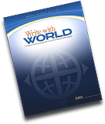
Members of this year's Crew had an exciting opportunity: reviewing the brand-new Write with World middle school writing program, so new that we received a pre-release copy of the first year of the two-year curriculum. This means that what we got was not the final version; there will probably be some improvements made before the Summer 2012 release, though the program is already impressive.
World Magazine is a bi-weekly, full color news magazine written from a Christian worldview. On its pages you'll find news articles, political cartoons, book and movie reviews, commentary, and more. We've been reading World for years, and our girls have been reading the student news magazines God's World News during the school year. There are editions for all grades, from preschool through high school, each edition crafted for a specific level of understanding, maturity (meaning that the news stories are presented in a way appropriate to the target age), and reading ability.
We appreciate the thought that goes into World, and the high quality of the publication, and so we expected no less of this writing curriculum.
Even so, Write with World far surpassed my expectations.
The purpose of the curriculum is to develop competent writers who can think and express their thoughts to others. Unlike some of the contrived curricula we've seen (you've heard the cliches, like "How I spent my summer vacation" or "A description of my bedroom), this course is intensely practical, for example, with assignments based on current events, multiple assignments to choose from, and models of writing (both good writing, and models that need improvement) for practice. Critical thinking and reading skills are incorporated, based in a Biblical worldview.
We received two books, the teacher/parent guide and the student workbook. It's hard to tell from the picture of the book cover... but when you open the book you find multi-colored pages with wide margins that invite note-taking. The main text is black-and-white, with accents in red, and the occasional color illustration, which might be a photo or drawing.
The student book is written directly to the student, from the general introduction ("Don't skip this part!") all the way to the end ("Congratulations!" on finishing the final exercise). All along the way there's give-and-take between the student and the authors (World Magazine editors and writers, and fellow students who instruct, ask guiding questions, and provide thoughts about how they approach writing, along with writing samples that show how they approached the same assignments as the student working through the course.)
The teacher/parent guide contains all the pages of the student text, along with teaching helps, including introductory material for each of the four units (content and purpose of each lesson, grading guidelines, suggestions for offering feedback, helping your student succeed and build skills) and specific comments on lesson material in margin notes -- there's no paging back and forth as you are literally on the same page with your student as you're going through the material.
Much more than writing is covered, of course, for writing involves using language effectively, which means that your student will also be learning about grammar (not in isolation, but while actually using and applying concepts) and building vocabulary along with learning and practicing writing and critical thinking.
Lessons follow a standardized format, beginning with a materials list for the lesson. Invariably this includes the student's journal, a record of the student's work as well as a place to brainstorm, to answer prompts, to write down thoughts. Other materials needed, depending on the lesson, might be a dictionary and/or thesaurus, highlighter, personal photographs, a copy of World Magazine or Top Story (the middle school student magazine), notecards, or a glue stick.
An exciting facet of the program is the interactive website, scheduled to launch in September 2012, that will offer updated lessons and additional resources.
Our take? I love this program! It's fresh but not dumbed down. The assignments aim at being relevant to the student. The tone is conversational while also informative.
Some things I'd like to see in the finished version that weren't in the version we saw:
- Table of Contents
- Answer keys, for example, for the vocabulary exercises
- Index
- Glossary of terms
Pricing and availability
Write with World can be ordered at this link. You can order now, and the curriculum is scheduled to ship this summer. The full curriculum (Year One and Year Two) is available for $165, or you can buy the years individually for $95 each. The purchase price includes a set of books (one teacher and one student) plus online access to the Write with World website. Shipping and handling charges are extra.
Read more TOS Crew reviews of Write with World at this link.
Disclaimer: Our family received a pre-publication copy of Year One of Write with World for review purposes. No additional compensation was involved.

Subscribe to:
Posts (Atom)